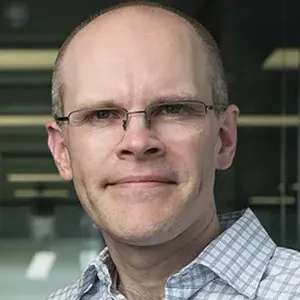
Speaker Bio
Steve Hodges is a Distinguished Professor in Computing and Digital Systems at Lancaster University, where he creates new digital devices, tools, and experiences that change what people do with technology. He works at all scales from prototype to production, and has contributed directly to millions of devices with tens of millions of users. His projects span domains such as the Internet of Things, mobile & ubiquitous computing, assistive technologies, and education.
Steve is also a passionate proponent and communicator of all things tech. The impact of his work, inspiring and empowering over 70 million children to be technology creators, has been acknowledged with the IET Mountbatten Medal and the Queen Elizabeth Prize for Education. He is also a Fellow of the ACM, the IEEE and the IET, and a member of the ACM SIGCHI Academy.
Leveraging the magic of physical computing with the BBC micro:bit
Prof. Steve Hodges, Lancaster University
Thursday 21st May 2026. 14:30 - 15:30. (Hybrid) Pugsley Theatre (Queens Building, 1.40).
Physical computing – building and coding digital systems that sense and respond to the physical world – has a magical ability to engage, inspire and empower learners of all ages. In this talk I’ll present some of the projects that have explored this phenomenon, describe how they fed into the BBC micro:bit project a decade ago, and reflect on how the micro:bit has evolved since then.
Fast-forward to today, and over eleven million micro:bits have been made; every second, someone somewhere starts coding a new micro:bit program. But we’re not done yet! I’ll end by presenting some of our work at Lancaster University to explore new opportunities for physical computing with the ambition of reaching one hundred million learners.
Teams meeting link: https://teams.microsoft.com/meet/355263363446856?p=1nq4Do8mRLVZZcGzZi
Pizza will be provided from 2 pm to 2:30 pm (Gluten-Free and Vegan options available).