Playing with Constraints: Designing Inclusive Games and Controllers
Monday 2nd November 2026. 1:30PM - 5:00PM. York, UK and Online.
How can we design inclusive games that appeal to gamers with different abilities? This workshop invites the CHI PLAY community to play with constraints and conceptualize games that enable forms of play beyond conventional patterns. We build on prior work that applies the concept of "impaired technologies" as a design provocation in a game jam to encourage alternative perspectives on play. Participants will create multiplayer games that are played with impaired technologies or, as an extension, that use novel interactions. We aim to engage researchers and practitioners interested in designing playful prototypes, including digital games, immersive experiences, tangible toys, and game controllers.
Accessibility
At the beginning of the session, participants will be reminded of several important guidelines for a smooth workshop experience: to take as many breaks as they need, to introduce themselves before speaking, and to create a safe space by not calling on specific individuals to contribute. Live captioning will also be available. We will plan for alternative forms of involvement, such as writing on post-it notes, using the online shared collaborative space Padlet (a visual collaboration software), and working in small teams or individually. The workshop is available in a hybrid format. Additionally, we invite participants to bring and use pillows, blankets, noise-cancelling headphones, or other bodily extensions that make them more comfortable.
Activities and Interactive Components
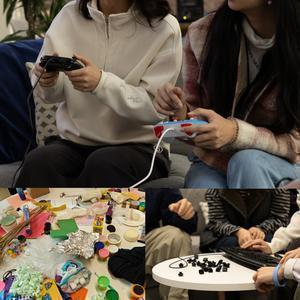
We will provide the games, impaired technologies, and craft materials required for participation. Online participants can create their own constraints by using post-it notes or paper to cover parts of their monitor. We will provide examples and ask online participants to take a photo of their post-it note arrangement and share it. Participants will need to bring their own laptops if they wish to prototype their games digitally.
Part 1: Gaming with Impaired Technologies (45 Minutes)
Participants will be invited to play games with various impaired technologies provided by the organizers. Participants can also spectate other games in play by other participants, which will be live-streamed via Teams for online participants. Throughout this gaming session, the organizers and participants will use Padlet or post-it notes to write down their impressions about the experience of playing using impaired technologies. Some potential discussion questions include:
-
In what way did you feel constrained while playing the game?
-
What did you feel you were able to do in the game?
-
How did you work with the constraints to make new possible actions and fun?
Finally, we will propose teams for participants who completed the web form; we will ask that all participants form teams or confirm individual involvement at the end of this phase. Participants will then collaborate within these teams to create new games.
Part 2: Game Conceptualization or Physical Prototyping (75 Minutes)
Participant teams will be asked to conceptualize their own multiplayer games that are played with impaired technologies, which may be extended using novel interactions (e.g., unconventional ways of interacting with games, custom controllers, etc.). They can create and communicate their game concepts by vibe-coding, prototyping using craft materials, or role-playing. We will encourage participants to consider designing beyond what existing controllers look like, and consider devices that can both accept inputs and return outputs.
Part 3: Pitch and Discussion (60 Minutes)
Each team will have a few minutes to demonstrate their designs from Part 2 to all workshop participants. The goal is to present their inclusive games as a pitch that appeals to mixed-ability gamers (disabled and non-disabled).
They will be invited to share their designs with either presentations or bodystorming simulations. After each demonstration, all workshop participants will then discuss the following questions:
-
How were constraints incorporated into gameplay? What unexpected interactions emerged?
-
Who (if anyone) is excluded from playing this game? What adaptations could be made to support them?
-
What would be necessary for this game to be realized? How can commercial games learn from these ideas?
Throughout the workshop, we will continuously integrate input from the online, anonymous written space on Padlet or Post-it notes into the spoken discussion.
Part 4: Conclusion (30 Minutes)
In closing, we will offer participants the opportunity to share any remaining thoughts and compile perspectives from the alternative forms of participation. These final insights will also be documented on Padlet. With participants' permission, we will compile game concepts and upload them to a gallery on the workshop website, to facilitate sharing and future reference.
If you have any questions about this event, you can email us at imptech-workshop@bristol.ac.uk
Organisers
Priscilla Y. Lo (she/her) is a PhD student at the Diverse-Ability Interaction Lab within the Bristol Interaction Group (BIG) at the University of Bristol. She has a background in games design and her prior research ranges across games, AI, and cross-sensory correspondences. Her current research explores leveraging playful inclusive public engagement events (e.g., game jams) to encourage people with different abilities to imagine alternative sensory interactions beyond traditional audiovisual media.
Grace Stangroome (she/her) is a PhD student at BIG, University of Bristol. Her research aims to understand how HCI can be used to improve co-working in mixed-ability (disabled and non-disabled) university student groups.
Vishal Joshi (he/him) is a PhD student in the Interactive AI Centre for Doctoral Training at the University of Bristol, affiliated with BIG. His research aims to understand cooperation between LLM-agents as well as human-LLM cooperation, with a particular focus in table-top roleplaying game settings.
Jack Burnett (he/him) is a PhD student in the Interactive AI Centre for Doctoral Training at the University of Bristol. His research focuses on democratizing game hardware to enable low-tech approaches to individualized solutions, including accessible and adaptive controllers.
David Thue (he/him) is an Associate Professor of Information Technology at Carleton University, where he leads the RISE (Reasoning for Interactive Systems and Experiences) research group. His work spans games and other interactive technologies, with a focus on the intersection between Artificial Intelligence and Human-Computer Interaction.
Oussama Metatla (he/him) is an Associate Professor of Human-Computer Interaction at the University of Bristol, where he co-directs BIG and leads the Diverse-Ability Interaction Lab. His research explores cross-sensory interaction, cross-modal perception, and embodied cognition to co-design technologies that enable more inclusive interactions between disabled and non-disabled people.