Puppet Prototyping: Exploring Puppetry as a Design Method for Relational Robots
2026. Designing Interactive Systems Conference (DIS '26).
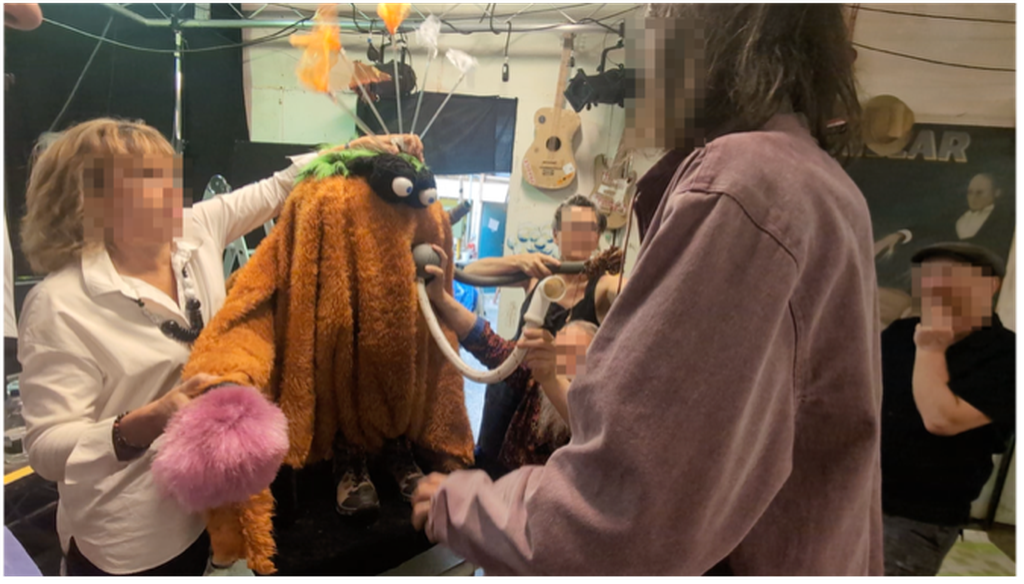
As robots are increasingly designed to take on relational qualities, new methods are needed to explore how their form, movement, and presence shape connection. We introduce puppetry as an embodied design practice in which designers and users inhabit and control physical prototypes to examine relational qualities before technical implementation. We ground this in equine-assisted interventions, where horses act as relational partners: their unpredictability, reciprocity, and embodied risk require humans to attune and regulate emotions. We utilised puppeteering to re-enact these dynamics safely through movement, materiality, and interaction, surfacing how such qualities may inform relational robots. Our findings show that puppeteering functions as a generative practice: movement becomes inquiry, playful performance reveals affective states, and low-fidelity prototypes enable safe exploration of relational complexity. Puppetry thus offers a pathway for developing robots as autonomous, equal partners; revealing insights into agency, coembodiment, and materiality, often overlooked in traditional prototyping.