Relationship-specific patterns of bodily access extend to digitally mediated touch
2026. Computers in Human Behavior Reports.
Roberto Montano Murillo, Orestis Georgiou, William Frier, Patrick Haggard & Patricia Cornelio.
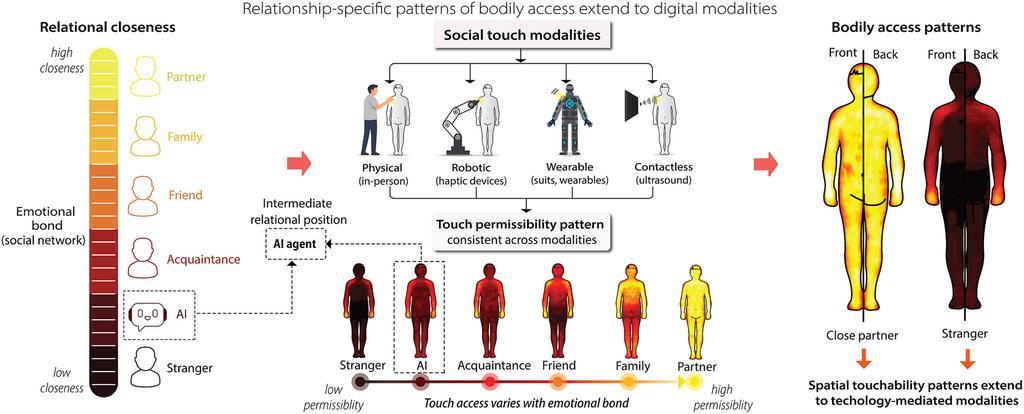
Social touch is shaped by relationship closeness and culturally influenced boundaries. However, emerging digital systems are reshaping how touch can be experienced, enabling touch-like sensations to be delivered remotely via robotic, wearable, and contactless interfaces. Yet, it remains unclear whether relationship-dependent patterns of touch permissibility observed in everyday life also extend to technology-mediated touch. In an online body-mapping study, 147 participants from six countries rated emotional bond toward multiple social-network members and an AI agent and indicated which body regions they would allow each target to touch across physical and three technology-mediated modalities. Across modalities, emotional bond robustly predicted a touchability index derived from the mapped body areas, indicating a consistent positive association between relationship closeness and touch permissibility even when tactile sensations are technologically delivered. This relationship-dependent pattern was observed across countries, alongside cross-cultural differences in baseline permissiveness and gradient strength. Touch-allowed maps further showed that mediated modalities exhibited spatial patterns broadly similar to those observed in physical touch, with closer network members granted access to broader and more intimate regions, and distant ties largely restricted to distal, socially neutral areas. AI agents were permitted greater bodily access than human strangers but exhibited weaker bond dependence and were more strongly associated with pragmatic than affective motives for touch. Together, these findings suggest that technology-mediated touch may be interpreted through existing relationship-dependent expectations governing bodily boundaries, rather than constituting a fully distinct category of digital interaction.